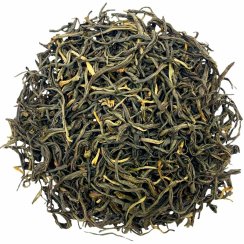

Ying Hong #9 - Guangdong Black Tea | Ying Hong Jiu Hao - Option: 50 g
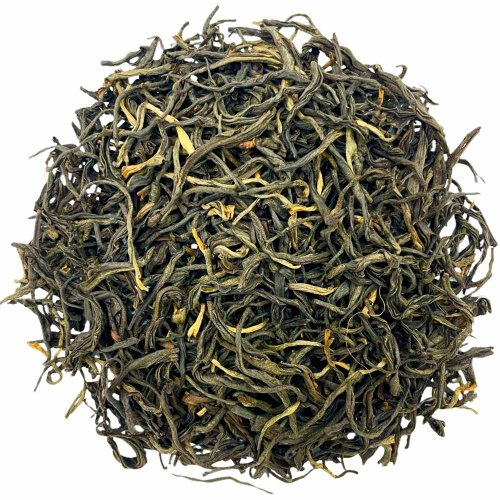
Ying Hong #9 (英红九号, Yīng hóng jiǔ hào) is a tea that at first glance appears rather unassuming. It carries the simple designation “number nine,” as if it were just another entry in a long line of breeding experiments. And yet, it is precisely within this modesty that a story begins to unfold—one that clearly reflects how Chinese tea has evolved over the course of the 20th century. No longer only a tradition passed down from generation to generation, but also a conscious work with the plant, the landscape, and the nature of taste itself. More
Ying Hong #9 (英红九号, Yīng hóng jiǔ hào) is a tea that at first glance appears rather unassuming. It carries the simple designation “number nine,” as if it were just another entry in a long line of breeding experiments. And yet, it is precisely within this modesty that a story begins to unfold—one that clearly reflects how Chinese tea has evolved over the course of the 20th century. No longer only a tradition passed down from generation to generation, but also a conscious work with the plant, the landscape, and the nature of taste itself.
Its home lies in the region of Yingde (英德) in Guangdong province, where the Ying Hong brand itself was established. Its origins date back to 1951, when the state-owned tea enterprise Yinghong Overseas Chinese Tea Farm (英红华侨茶场) was founded. From here, Yingde black tea began its journey into the world as an export product representing China. This enterprise was not merely a plantation, but also a center of research and cultivation, where different tea cultivars were systematically studied and developed. Over time, one of the richest collections of tea plant varieties in China was established here, enabling the long-term development of new tea types. In the 1950s and 60s, Yingde also played an important economic role, as black tea was among the key export commodities. During the second half of the 20th century, a distinct style of black tea gradually took shape here—different from traditional regions such as Yunnan or Anhui. More refined, more aromatic, and more focused on fragrance than sheer strength.
Ying Hong #9 emerged as the culmination of this development. Its foundation lies in the large-leaf tea variety from Yunnan (云南大叶种 Yúnnán dà yè zhǒng), which was gradually refined and adapted to local conditions. This process took decades and involved extensive research as well as the collection of genetic resources from various parts of the world. It was only in the 1990s that a stable cultivar was established—one that combined a rich internal composition with a distinctive aromatic profile ideal for black tea production.
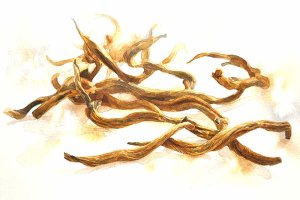
Ying Hong #9 英红九号 - Oriental Golden Beauty
Ying Hong #9 (英红九号, Yīng hóng jiǔ hào) is a tea that at first glance appears rather unassuming. It carries the simple designation “number nine,” as if it were just another entry in a long line of breeding experiments. And yet, it is precisely within this modesty that a story begins to unfold—one that clearly reflects how Chinese tea has evolved over the course of the 20th century. No longer only a tradition passed down from generation to generation, but also a conscious work with the plant, the landscape, and the nature of taste itself.
Alternative products2

Yunnan Golden Needles FBOP | Dian Hong Jin Zhen
3,48 € excl. VAT
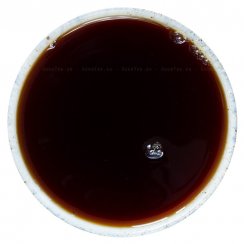
Guangdong Black Tea | Ying De Hong Cha
5,36 € excl. VAT