

Yao Qing Style White Peony 摇青白牡丹
When White Tea Borrows from Oolong
Among the traditional Chinese tea categories, white tea is often described as the simplest. The leaves are picked, allowed to wither and finally dried. There is no fixation as in green tea, no deliberate rolling and extensive oxidation as in black tea, and none of the elaborate zuo qing process associated with oolong. Yet simplicity does not mean inactivity. During the long hours of withering, the leaf remains alive and chemically active, slowly losing water while its aroma, taste and structure are transformed. Modern research into white-tea manufacture confirms that both prolonged withering and final drying play major roles in the formation of its characteristic aroma.
It is precisely within this seemingly simple stage of withering that some contemporary tea makers have begun to experiment. One particularly interesting example is Yao Qing White Peony – 摇青白牡丹, a style in which the traditional white-tea process meets a technique borrowed from oolong manufacture.
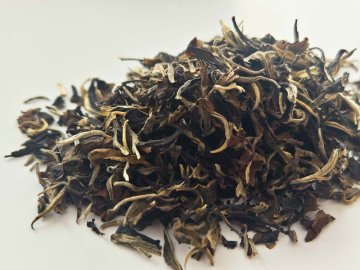
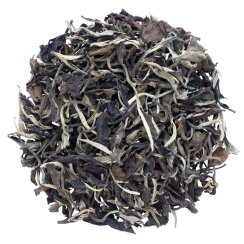
The result can look strikingly unlike classical White Peony. Green, grey-green and silver leaves may be accompanied by reddish-brown areas, dark edges and sometimes leaves whose one surface has become deep brown or almost black. The aroma can also depart considerably from the quiet hay, herbs and gentle sweetness associated with traditional white tea, moving instead toward flowers, ripe fruit, honey and a remarkably expressive perfume.
To understand why, it is necessary to look first at what White Peony – 白牡丹 Bái Mǔdān actually is.
From Silver Needle to White Peony
White Peony is not the name of a tea-tree cultivar. Traditionally it describes a grade and style of white tea defined largely by the material that is harvested.
Where Baihao Yinzhen 白毫银针 – Silver Needle consists essentially of young unopened buds, White Peony includes the bud together with developed leaves. Traditional descriptions generally refer to a shoot consisting of one bud and one or two young leaves, although historical and regional grading has never been entirely uniform. Zhang Tianfu's important survey of Fujian white tea describes Bai Mudan as white tea produced from shoots of Da Bai or Shui Xian tea plants carrying a bud and two or three leaves, illustrating how historical definitions could be somewhat broader than the neat modern commercial grades.
This apparently small difference changes the tea considerably.
A bud is covered in fine white trichomes and contains a different balance of aromatic and taste compounds from the more developed leaves below it. Once leaves become part of the plucking standard, White Peony acquires greater body, a broader aromatic spectrum and often considerably more depth than Silver Needle.
Visually, the silver bud rests between the spreading leaves. The Chinese saw in this arrangement something resembling a flower opening in water – green leaves surrounding a pale centre like the petals of a peony. Hence the name:
白牡丹 – Bái Mǔdān – White Peony.
Traditional descriptions even speak of the leaves embracing the silver bud, 两叶抱一芽, creating the characteristic flower-like appearance.
A relatively young tradition
Tea has an ancient history, but the categories we now call the six Chinese tea types did not all appear simultaneously. White tea in its recognizable modern manufactured form is comparatively recent.
The historical development is closely connected with northern Fujian. Zhang Tianfu's research places the beginnings of white-tea manufacture in Fuding, followed by its development in Shuiji and later Zhenghe. Fuding's Da Bai cultivar was identified in the nineteenth century, and by the late nineteenth century its large, down-covered buds were being used for Silver Needle. Zhenghe subsequently developed its own production.
White Peony appears somewhat later.
Its precise first year is difficult to establish. Historical accounts associate its creation with Shuiji 水吉, today part of Jianyang in Fujian. Local historical material from Jianyang identifies the Shuiji–Dahu area as the original home of Bai Mudan, while Zhang Tianfu wrote that its exact date of creation still required further investigation. What is considerably clearer is that Zhenghe began producing White Peony around 1922, after which it became one of the important centres of the style.
There is another fascinating detail hidden in this history. Jianyang sources maintain that the earliest White Peony was associated particularly with Shui Xian 水仙, rather than being exclusively the product of the Da Bai cultivars that are now so strongly associated with white tea. Later, material from Da Bai cultivars became incorporated into White Peony production.
White Peony therefore was never quite as rigid a concept as modern packaging can make it appear. It was a style created through the interaction of plucking standard, cultivar, terroir and white-tea processing.
And that flexibility eventually allowed the idea of White Peony to travel far beyond Fujian.
White Peony arrives in Yunnan
When white-tea processing moved into Yunnan, it encountered very different plant material.
Much Yunnan tea is produced from local large-leaf tea populations generally associated with Camellia sinensis var. assamica, including cultivated old gardens and, in some cases, material from old trees. The leaves can be considerably larger and more substantial than those commonly encountered in Fujian White Peony.
Applying the White Peony concept to this material creates something distinctive.
The basic principle remains recognizable: a tender shoot containing a bud and young leaves is harvested and processed as white tea. But the larger Yunnan leaf brings its own character. The resulting teas can possess greater body, darker fruitiness and a powerful sweetness. Depending on origin, season and processing, they may suggest honey, dried flowers, meadow herbs, stone fruit, tropical fruit or dried fruit.
For this reason, Yunnan White Peony should perhaps be understood less as an attempt to imitate Fujian Bai Mudan and more as the adaptation of the Bai Mudan plucking and processing concept to Yunnan material.
And some Yunnan tea makers have taken that adaptation one step further.
They shake the leaves.
摇青 Yáo Qīng – “shaking the green”
摇青 Yáo Qīng can literally be understood as “shaking the green.”
The technique belongs historically to oolong manufacture, where it forms part of the broader process known as 做青 zuò qīng – “making the green.” Freshly withered leaves are gently shaken, tossed or agitated and then left to rest. The cycle can be repeated several times, with the tea maker changing the duration and intensity according to the condition of the leaves.
It sounds simple. Biochemically, it is anything but.
As leaves collide with one another and with the surface of the baskets or machinery, their tissues experience mechanical stress. The most obvious damage often occurs around the edges, but microscopic injury can also occur across the surface. Cell structures that normally keep certain compounds and enzymes apart are disturbed.
The leaf then rests.
During this resting period, enzymatic oxidation and numerous related metabolic processes alter its chemistry and aroma. The leaf is therefore not merely drying: it is responding to dehydration and physical stress.
This alternating rhythm is important:
wither → shake → rest → shake → rest → dry
The tea maker is effectively manipulating the living leaf.
In traditional oolong this process can be extraordinarily sophisticated. The leaves are smelled, touched and observed between rounds. The next treatment depends upon their condition rather than simply upon a timer.
What happens when Yao Qing is applied to white tea?
Here lies the apparent contradiction.
Classical white tea is famous precisely because the leaves are not rolled or aggressively manipulated. Traditional manufacture essentially consists of withering followed by drying. Scientific studies of white tea show that this prolonged withering alone already causes extensive changes in volatile compounds and their precursors; the apparent simplicity of the process conceals considerable biochemical activity.
A recent study specifically examining White Peony also demonstrated just how strongly the method of withering influences aroma. Sunlight and dark withering produced different aromatic profiles, with changes involving compounds including linalool, β-ionone, benzeneacetaldehyde and green-leaf volatiles. In other words, even without shaking the leaves, changing their environment during withering can significantly change what we eventually smell in the cup.
Yao Qing introduces another variable: controlled mechanical stress.
Instead of allowing the leaves to remain almost completely undisturbed throughout the withering period, the tea maker gently agitates them. The objective is not to roll them into shape or squeeze out their juices. Proper Yao Qing is considerably subtler than rolling.
The leaves are bruised just enough to alter the course of their transformation.
After shaking, they are spread again and allowed to rest. Depending on the producer, the procedure may be performed once or repeated several times. There is no single universal recipe for a “Yao Qing white tea”; it is better understood as a family of experimental or adapted techniques.
This distinction is important because the term Yao Qing White Peony does not define a fixed oxidation percentage.
Why one side of a leaf can become almost black
The dry leaves themselves often reveal what happened during manufacture.
In conventionally processed White Peony, we might expect silver buds surrounded by green, grey-green, olive or somewhat brownish leaves. Some reddish coloration is entirely normal because white tea is not fixed at the beginning of manufacture and enzymatic oxidation continues during withering.
With Yao Qing, however, the pattern can become much more dramatic.
One leaf may remain predominantly olive-green while its edges become red-brown. Another may carry dark patches. And occasionally one side of a leaf can become deep brown or almost black while the opposite side remains considerably greener.
This does not necessarily indicate burnt or defective tea.
A leaf is not a homogeneous piece of material undergoing transformation at precisely the same rate everywhere. During shaking and subsequent resting, different parts of it experience different degrees of mechanical stress. Contact between leaves, pressure, orientation, airflow and local moisture conditions can all vary.
The result is spatially uneven oxidation.
This is an important way of understanding Yao Qing white tea. Calling the tea simply “20% oxidized” or “30% oxidized” may give a misleading picture. One area of a leaf can remain relatively little transformed while another has undergone much more extensive oxidation.
Thus a single leaf can almost become a map of its own processing history:
silver → green → olive → red-brown → dark brown
Sometimes all of these colours occur on the same shoot.
The almost black surface seen on certain Yao Qing Yunnan White Peony leaves can therefore be understood as the visible consequence of strongly localized transformation during manipulated withering, rather than evidence that the whole tea has been processed like black tea.
But isn't this simply an oolong?
Not necessarily.
This is where classification by appearance or oxidation percentage becomes problematic.
Oolong is not merely “partially oxidized tea.” Its identity derives from a particular sequence of processing, most importantly the complex zuo qing 做青 stage and eventually sha qing 杀青, the heating or fixation step that arrests enzymatic activity. Rolling and roasting may follow in various forms.
Traditional white tea takes another route:
plucking → withering → drying.
There is normally no early fixation.
A Yao Qing white tea effectively inserts controlled agitation into the withering stage:
plucking → withering → Yao Qing → resting/wither → possibly further Yao Qing/resting → drying.
If it is subsequently dried as white tea rather than fixed and manufactured as an oolong, it still makes sense to regard it as an experimental white-tea process borrowing an oolong technique, rather than simply calling it oolong.
The border, however, is genuinely interesting.
Tea categories are human systems imposed upon a continuous range of biochemical transformations. Yao Qing White Peony deliberately walks close to one of those borders.
Aroma – the principal reason for shaking
The purpose of Yao Qing is not merely to make unusual-looking leaves.
It is primarily about aroma.
Classically processed White Peony can be wonderfully aromatic, but its fragrance is often restrained: fresh vegetation, hay, wildflowers, herbs, subtle fruit and honey. Long withering gradually replaces some of the fresh green character of the living leaf with sweeter and more floral aromas. Research has identified a large number of volatile compounds changing dynamically during white-tea withering, demonstrating how much aromatic construction takes place during this apparently passive period.
Mechanical agitation can push this transformation in another direction.
A well-made Yao Qing Yunnan White Peony may consequently display more obvious floral fragrance, ripe fruit, honey, stone fruit and sweet exotic notes, while some of the raw grassy character becomes less prominent.
The exact result depends enormously on the raw material and on how aggressively the technique is applied.
Gentle Yao Qing can simply lift the fragrance.
More pronounced Yao Qing can produce a tea whose perfume immediately recalls lightly oxidized oolong.
Taken too far, however, the freshness and delicacy expected from white tea can disappear beneath heavy oxidation. The skill lies in stopping before aromatic complexity becomes heaviness.
Yunnan makes the technique particularly expressive
Yunnan is an especially interesting place for this experiment because its large-leaf material can respond dramatically to prolonged withering and oxidation.
The substantial leaves contain enough material to develop a deep flavour while still retaining the gentle texture characteristic of white-tea manufacture. Where Fujian White Peony may emphasize finesse, downy sweetness and freshness, Yunnan examples can become broader and more voluptuous.
Yao Qing amplifies this tendency.
The tea can occupy an unusual sensory space: it may possess the softness and unforced structure of white tea, the aromatic exuberance associated with oolong, and some of the fruit depth more commonly encountered in oxidized Yunnan teas.
Yet good examples should not taste like an unfinished black tea.
Their character depends precisely upon the tension between transformation and restraint.
White tea as a process, not an absence of process
Perhaps Yao Qing White Peony is most interesting because it challenges one of the common misconceptions about white tea: that white tea is tea to which almost nothing happens.
Quite the opposite.
The white-tea maker works largely through time, water loss, temperature, humidity, airflow and the physiology of the harvested leaf. Instead of quickly arresting the leaf as in green-tea manufacture, the producer permits it to remain active for many hours.
Withering is therefore not simply dehydration.
Aroma precursors are transformed. Volatile compounds appear and disappear. Green aromas diminish while floral, sweet and fruity components develop. Research into White Peony confirms that even something as seemingly modest as choosing sunlight rather than dark withering changes the eventual aromatic balance.
Yao Qing takes this philosophy and adds movement.
The leaf is allowed to change naturally, but at selected moments the tea maker intervenes: a shake, a toss, a period of rest. Then another observation.
It is an approach surprisingly compatible with the spirit of white tea. The intervention is small; its consequences are large.
Between tradition and experimentation
Historically, Bai Mudan emerged as its own style through adaptation. It developed after Silver Needle, spread from the Jianyang/Shuiji area toward Zhenghe and came to be produced from different cultivars, including Shui Xian and the various Da Bai types.
Its journey to Yunnan is another chapter in that evolution.
And Yao Qing White Peony represents a further step.
It should not be presented as an ancient Yunnan tradition. The traditional history of Bai Mudan belongs to Fujian, while the use of Yao Qing in Yunnan white tea is better understood as a modern cross-pollination of processing traditions. What makes it interesting is precisely that it does not pretend that tea styles must remain frozen in the form in which they first appeared.
A technique developed for oolong can reveal something new in white tea.
A Fujian plucking concept can reveal something new in Yunnan leaf.
And a tea that at first seems visually strange – silver buds beside leaves mottled green, copper, brown and almost black – begins to make sense once we understand that those colours record what happened during withering.
摇青 Yáo Qīng – shaking the green – is therefore much more than shaking leaves.
It is the deliberate use of movement followed by stillness.
Contact followed by rest.
A small amount of damage followed by hours in which the leaf responds to it.
In classical White Peony, transformation is allowed to unfold quietly. In Yao Qing White Peony, the tea maker occasionally gives that transformation a gentle push.
The tea remains recognizably white, yet its fragrance and appearance reveal the influence of another great Chinese processing tradition. That tension between 白茶 báichá – white tea and 乌龙茶 wūlóngchá – oolong is exactly what makes Yao Qing Yunnan White Peony such a fascinating style.
Recommended products1
2026 Yao Qing Style Yunnan White Peony | Ming Qian Yao Qing Bai Mu Dan
8,57 € excl. VAT