

Tea Through the Seasons: How Yin and Yang Transform in Nature

Throughout the year, nature constantly moves between two complementary forces – yin and yang. They are not opposites in the usual sense, nor do they represent good and bad. Yin is associated more with cold, stillness, moisture, darkness and inward movement. Yang is connected with warmth, light, activity, dryness and outward movement.
Tea, however, is not simply “yin” or “yang”. Its effects are influenced by the tea plant variety, where it is grown, how it is processed, its age, roasting and preparation. Even so, the principle of yin and yang can serve as a useful guide when choosing tea according to the season and our current state of mind and body.
Spring: yang awakens
In spring, yang begins to rise. Sap flows upwards, plants sprout and nature starts moving again after its winter rest. Yin is still present in the cold mornings and damp soil, but it gradually gives way to increasing light and warmth.
Fresh, fragrant and invigorating teas that are neither overly cooling nor overly warming are well suited to spring. Delicate green teas, lightly oxidised oolongs or high-quality light teas from the first spring harvests are often good choices.
Suitable examples include:
-
Chinese green teas such as Long Jing, Bi Luo Chun or Anji Bai Cha,
-
Japanese sencha and kabusecha,
-
light oolongs such as Tie Guan Yin,
-
a delicate first-flush Darjeeling,
-
fresh Bai Mu Dan white tea.
Green tea has a predominantly yin, cooling character. At the beginning of spring, it may therefore not suit everyone, especially on an empty stomach or during cold days. Light oolongs are closer to the centre: they retain the freshness of green leaves, but partial oxidation softens their cooling effect.
Spring tea should resemble the season itself – light, aromatic and full of life.
Summer: the peak of yang and the birth of yin
In summer, yang reaches its peak. The days are longest, nature is open and active, and heat moves upwards and outwards. Yet it is precisely at the moment when yang is strongest that yin begins to be born. After the summer solstice, the days start to shorten again and nature very slowly begins to turn towards autumn.
In hot weather, we usually seek light, fresh and cooling teas. Teas that have undergone little oxidation and have not been heavily roasted have the strongest yin character.
Especially suitable for summer are:
-
green teas,
-
yellow teas,
-
fresh white teas,
-
very light floral oolongs,
-
young sheng pu-erh,
-
and, on cooler summer evenings, lighter red teas.
Green and yellow teas are refreshing, and their aroma often evokes grass, flowers, fresh herbs or young vegetables. White teas tend to be softer and rounder, yet they generally retain a yin character.
Young sheng pu-erh can feel distinctly fresh and even cooling. At the same time, it is often very intense in both flavour and stimulating effect, so it may not be suitable on an empty stomach or for someone sensitive to caffeine.
Tea does not have to be served iced in summer. A lukewarm or warm infusion may be more pleasant than a drink full of ice, which cools the body abruptly. Cold brewing is another good option, producing a delicate, sweeter and less astringent infusion.
Late summer: the season of the centre
Traditional Chinese thought sometimes also distinguishes late summer – a time of ripening, harvest and a return to the centre. The heat is no longer as sharp, moisture appears in the air and nature begins to stabilise.
Balanced teas with a fuller flavour suit this season:
-
medium-oxidised oolongs,
-
lightly roasted oolongs,
-
aged white teas,
-
delicate red teas,
-
a milder shu pu-erh.
The ideal tea is neither too green and cooling nor yet endowed with a heavy winter character. Dong Ding, Oriental Beauty or a lightly roasted Tie Guan Yin are good examples.

Autumn: yang withdraws, yin grows
In autumn, yin begins to prevail. There is less light, temperatures fall and nature’s energy draws inwards. Leaves lose their green colour and fall. It is a season of maturity, slowing down and gradual closure.
As the weather cools, our desire for more aromatic, sweeter and more oxidised teas usually grows. Particularly suitable are:
-
darker and roasted oolongs,
-
teas from the Wuyi Mountains, also known as yancha,
-
red teas,
-
aged white teas,
-
mature sheng pu-erh.
Stronger oxidation and roasting move a tea towards yang. Roasted oolongs offer notes of wood, spices, nuts, baked fruit or minerals and pleasantly complement the drier, cooler character of autumn.
Red tea – called black tea in European terminology – is more oxidised and generally feels warmer than green tea. It does not have to be heavy, however. A delicate Chinese red tea may have honeyed, fruity or floral notes and can be well suited even to early autumn.
Winter: the peak of yin and the hidden seed of yang
Winter is the season of greatest yin. Cold, darkness, silence and inward movement prevail. Nature appears to rest, yet beneath the surface it preserves its strength for the next cycle. At the winter solstice, yin reaches its peak and yang begins to be born again.
In winter, we usually appreciate fuller, more mature and warming teas:
-
red teas,
-
more heavily roasted oolongs,
-
shu pu-erh,
-
mature sheng pu-erh,
-
dark teas such as hei cha,
-
long-aged white teas.
Shu pu-erh and other dark post-fermented teas tend to have an earthy, woody and rounded character. Traditionally, they are regarded as less cooling and suitable for the cold season. Roasted oolongs and red teas, meanwhile, offer sweet notes of cocoa, dried fruit, spices, honey or roasted nuts.
Winter tea can be prepared a little stronger and enjoyed during a quiet sitting. Some dark teas and mature pu-erhs can also be briefly simmered. This produces a richer infusion whose character is well suited to the most yin part of the year.
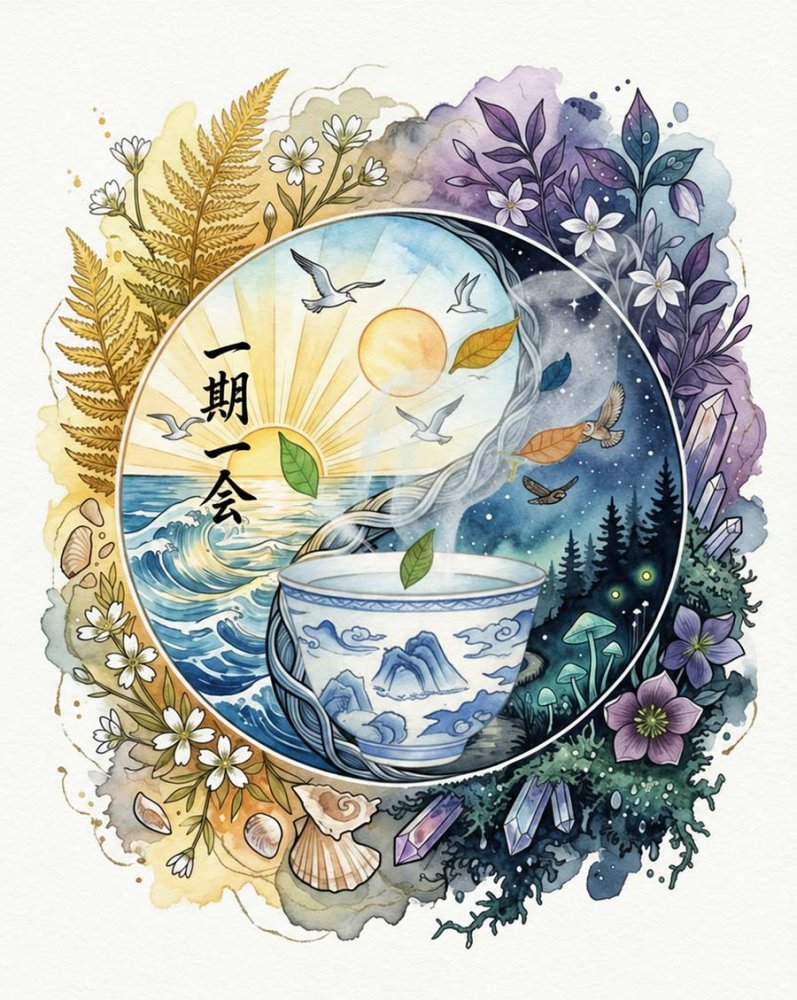
An approximate yin–yang scale of teas
From more yin to more yang, tea categories can be arranged approximately as follows:
-
green teas,
-
yellow teas,
-
fresh white teas,
-
young sheng pu-erh,
-
light oolongs,
-
medium-oxidised oolongs,
-
red teas,
-
dark and heavily roasted oolongs,
-
aged white teas and mature sheng pu-erh,
-
shu pu-erh and other post-fermented dark teas.
This order is not absolute. A heavily roasted green tea may feel different from a very delicate red tea. Ageing also usually transforms a tea’s sharp, fresh character into a calmer, deeper and more balanced expression.
Preparation also determines the result
The yin or yang character of a tea is not determined by its category alone. The method of preparation also plays an important role.
A more yin effect is usually associated with:
-
lower water temperature,
-
shorter steeping,
-
cold preparation,
-
a light, less concentrated infusion.
A more yang effect is associated with:
-
hot water,
-
a stronger infusion,
-
preheated teaware,
-
preparation in a small teapot with repeated infusions,
-
briefly simmering a suitable dark tea.
Personal experience is always decisive, however. The same tea may bring pleasant refreshment to one person while making another feel cold or restless. It depends on the weather, time of day, amount of tea, food and individual sensitivity.
Tea as a way of listening to nature
Choosing tea according to yin and yang does not mean following a rigid chart. The point is to observe changes in the world around us while also listening to our own bodies. On a hot day, a refreshing green tea may be a natural choice, while on a damp, chilly evening we may reach for a roasted oolong or dark pu-erh.
The annual cycle is not a sharp alternation of four separate seasons. It is a continuous wave: yang is born in the middle of winter, grows in spring and peaks in summer. It then turns inwards, while yin strengthens through autumn and reaches its peak in winter. Every cup of tea can become a small way to observe this transformation and consciously take part in the rhythm of the year.
The concept of tea’s thermal and energetic qualities comes from traditional Chinese philosophy and traditional systems of working with food. It is not a medical classification or a substitute for professional healthcare.