How the tàijí diagram 太极图 can help us understand the five organs
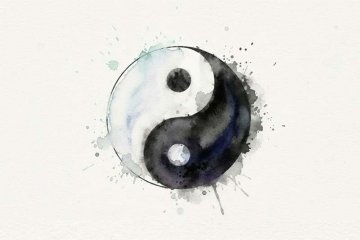
Traditional Chinese medicine does not see the body as a collection of separate parts, but as a living whole that continually adapts to its surroundings. This view is connected with the idea of Dào (道) – the natural order, or “Way,” according to which everything arises, changes, and returns to stillness. Dào need not be understood here as a religious rule or a precise guide to life. Rather, it refers to the natural course of things. Yīn and yáng (阴阳, yīnyáng) represent two interconnected aspects of this movement: night and day, stillness and activity, cold and warmth, descending and ascending. Neither can exist without the other, and each contains the seed of its opposite.
We can observe a similar principle when preparing tea – chá (茶). Water and heat, stillness and movement, time and the right measure work together to transform dry leaves into a drink. None of these elements acts alone. Water that is too hot or steeping that lasts too long can upset the balance, while suitable conditions allow the tea to unfold its aroma and flavour naturally.
The tàijí diagram (太极图, tàijí tú), commonly known as the yīn–yáng symbol, can likewise be seen as a map of continuous transformation. It helps us understand how traditional Chinese medicine describes the qualities of the five principal organs – wǔzàng (五脏). These are not merely organs in the anatomical sense. Each also represents a broader network of physical and mental functions, a particular direction in the movement of vital energy qì (气), and one phase of a natural cycle.
When “constrained heat” accumulates in the body
Before looking at the individual organs, let us consider an example that clearly illustrates this traditional way of thinking.
According to traditional Chinese medicine, if constrained or pent-up heat – yùrè (郁热) – develops because of dampness shī (湿), phlegm tán (痰), or food stagnation shízhì (食滞), and the symptoms worsen in the afternoon, simply using cooling remedies may not always be enough. Cooling remedies may ease the heat, but their cold nature can also slow the movement of qì. The heat that was already trapped could then become even more deeply constrained.
Imagine an overheated room. There are two ways to cool it:
-
turn on the air conditioning,
-
or open the doors and windows so that the hot air can escape.
The first option corresponds to direct cooling. The second restores circulation, allowing the accumulated heat to disperse naturally. In such a case, traditional treatment would focus primarily on freeing and dispersing yáng qì – shūsàn yángqì (疏散阳气). This involves methods that encourage the movement of qì and release the exterior of the body. Cooling remedies might then be added only as support.
This is where the principle of Dào becomes apparent: sometimes a problem need not be opposed with force. It may be more effective to remove the obstruction and allow the body to return to its natural movement. Specific treatments and the use of herbs should always be discussed with a qualified practitioner. Some herbs may cause adverse effects or interact with medicines.
The five organs and the five phases
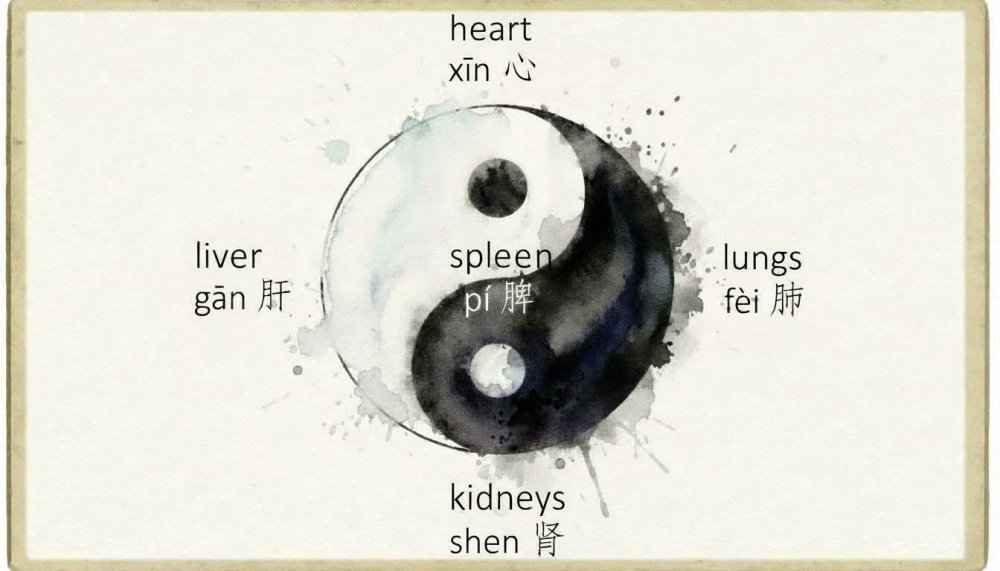
The better-known classification of the five principal organs according to the system of five phases – wǔxíng (五行) – is as follows:
-
the liver, gān (肝), belongs to wood, mù (木),
-
the heart, xīn (心), to fire, huǒ (火),
-
the spleen, pí (脾), to earth, tǔ (土),
-
the lungs, fèi (肺), to metal, jīn (金),
-
the kidneys, shèn (肾), to water, shuǐ (水).
The same organs can also be arranged according to the principle of yīn and yáng. The image of a single day – from sunrise through noon and sunset to midnight – can help us understand this.
-
The liver corresponds to young yáng – shàoyáng (少阳) – and sunrise.
-
The heart represents great yáng – tàiyáng (太阳) – and noon.
-
The lungs are associated with young yīn – shàoyīn (少阴) – and sunset.
-
The kidneys represent great yīn – tàiyīn (太阴) – and midnight.
-
The spleen stands at the centre as zhìyīn (至阴), the place of transition and transformation.
A tea infusion makes this movement almost visible. After water is poured over the leaves, some rise while others sink and gradually settle again. The aroma rises, while colour and flavour permeate the water. What was enclosed in the dry leaf unfolds through the action of water, heat, and time.
This is not an exact illustration of Chinese medicine, but it can help us imagine that yīn and yáng are not two motionless halves. They are directions and phases within a single unfolding process.
The liver: shàoyáng and sunrise
The liver corresponds to young yáng – shàoyáng (少阳). Its image is the sun rising in the east and gradually climbing towards the midday sky.
Its principal qualities are therefore upward movement, activity, and a gradual increase in energy. In traditional Chinese medicine, the liver ensures the free flow of qì. This function is called shūxiè (疏泄), meaning to course, free, and spread. This also corresponds to the liver’s association with the wood phase. A plant grows from the earth, reaches upwards, and spreads in every direction. In the same way, healthy liver qì should move and expand freely. If this flow becomes obstructed, the traditional view holds that feelings of tension, irritability, or inner pressure may arise.
The liver therefore represents the beginning of movement – the moment when stillness starts to become activity and yīn gradually changes into yáng.
The heart: tàiyáng and the midday sun
The heart is described as “great yáng within yáng” – yáng zhōng zhī tàiyáng (阳中之太阳). It represents noon, when the sun reaches its highest point and its power is at its greatest.
This image is connected above all with the heart’s unceasing activity. Throughout life, the heart propels blood through the vessels. In traditional terminology, “the heart governs the blood and vessels” – xīn zhǔ xuèmài (心主血脉). This requires a great deal of energy, so among the five organs the heart is regarded as having the strongest yáng aspect.
Traditional Chinese medicine also associates the heart with consciousness, mental clarity, and alertness. This function is expressed in the phrase “the heart governs the spirit shén” – xīn zhǔ shénmíng (心主神明). The word míng (明) means brightness or light. Just as the sun illuminates the world around us, the energy of the heart is said symbolically to maintain clarity of mind. Yet noon is not only the height of light; it is also the moment when its direction begins to turn. When yáng reaches its maximum, yīn begins to arise within it. This reminds us that no phase can continue growing indefinitely.
The lungs: shàoyīn and sunset
The lungs correspond to young yīn – shàoyīn (少阴). Their image is the sun setting and beginning to descend below the horizon.
According to traditional Chinese medicine, the lungs govern breathing and the movement of qì. Their action has two principal directions: dispersing upwards and outwards, called xuānfā (宣发), and descending downwards and inwards, called sùjiàng (肃降). The downward movement can be explained through cough, shortness of breath, or asthmatic symptoms. In these conditions, according to the traditional view, lung qì moves abnormally upwards. It therefore follows that its natural direction should be predominantly downwards. The lungs are also situated highest among the five organs. To interact with the organs below, their activity must extend down towards them.
Sunset here does not mean extinction, but a return inward. Activity calms, energy draws in, and yáng gradually gives way to yīn.
The kidneys: tàiyīn and midnight
The kidneys represent great yīn – tàiyīn (太阴) – corresponding to midnight. Darkness and stillness predominate at this time, yet even within the deepest yīn there remains a seed of yáng. This is why kidney yáng – shènyáng (肾阳) – is considered so precious in traditional Chinese medicine. It is relatively scarce, yet it is said to warm and support the whole body.
The kidneys are located in the lower part of the torso, so their warmth can symbolically rise upwards. This energy must, however, remain firmly rooted. If it is weakened or “leaves its place,” the traditional interpretation is that the body loses an important source of warmth and vitality.
Midnight is not the final end of the day. It is the moment when new light begins to arise in the midst of darkness. The kidneys therefore represent not only stillness and storage, but also the hidden foundation of renewed life and movement.
The connection between the heart and kidneys
The heart contains abundant yáng, while the kidneys are rich primarily in yīn. The two organs should therefore complement one another. The warmth of the heart symbolically descends to warm the kidneys. Kidney water, by contrast, rises to cool the heart and prevent its fire from becoming excessive. At the same time, it replenishes the heart’s yīn aspect. This balance is called “the connection between the heart and kidneys” – xīn shèn xiāng jiāo (心肾相交). It expresses the idea that the upper and lower parts of the body, like fire and water, must work together.
It is also a clear example of the yīn–yáng relationship. Opposites are not enemies here. They complement, restrain, and support one another. Warmth needs moisture, and water needs movement so that it does not become lifeless.
The spleen: zhìyīn and the place of transformation
The spleen occupies the centre of the whole system. In traditional texts it is described by the term zhìyīn (至阴).
The character zhì (至) does not mean “the greatest amount” or “the highest degree” here. Rather, it means “to arrive” or “to reach.” Zhìyīn can therefore be understood as the place where one arrives at yīn, or from which yīn turns once again towards yáng. The spleen symbolically forms the centre where yáng changes into yīn and yīn can turn back towards yáng. It connects and balances the other organs. This corresponds to its association with the earth phase. Earth receives, transforms, and provides nourishment. Similarly, according to traditional Chinese medicine, the spleen transforms food and creates from it the energy required by the whole organism.
The centre is therefore not a motionless point. It is the place through which change passes and where different forces can meet.
The whole picture at a glance
We can compare the pattern of the five organs to the course of a single day:
-
the liver, gān (肝), is shàoyáng (少阳), sunrise and the beginning of movement,
-
the heart, xīn (心), is tàiyáng (太阳), noon and the peak of energy,
-
the lungs, fèi (肺), are shàoyīn (少阴), sunset and movement inward,
-
the kidneys, shèn (肾), are tàiyīn (太阴), midnight and the storage of energy,
-
the spleen, pí (脾), is zhìyīn (至阴), the centre of transformation between yīn and yáng.
The purpose of this arrangement is not to divide the body into fixed compartments. Quite the opposite: it shows that no organ works alone and no state lasts forever. Activity passes into stillness, ascent into descent, and yīn transforms into yáng. From the perspective of Dào, health is not a motionless state of perfect balance. It is the body’s ability to respond continuously to change and find harmony again. The role of treatment is therefore not to control the body by force, but to help it return to its natural rhythm. Perhaps this is why tea fits this way of thinking so well. In its preparation, water cannot be separated from heat, the strength of the infusion from time, or aroma from flavour. The result is created not by one component but by the relationship among them.
A cup of tea – yì bēi chá (一杯茶) – can thus remind us, in a small and everyday form, of the central idea of the tàijí diagram: nothing exists in isolation, everything changes, and balance does not lie in immobility but in the ability to respond sensitively to change.
The tàijí diagram (太极图, tàijí tú) offers a simple map through which the traditional understanding of the five organs can be approached more clearly. It is important, however, to remember that this is a philosophical and therapeutic model of traditional Chinese medicine, not a substitute for modern physiology, medical diagnosis, or professional healthcare.