

Famous Villages of the Bada Mountains: Zhanglang 章朗 and Manmai 曼迈

The Bada 巴达 Mountains are among the most important ancient tea-growing areas in the western part of Menghai County 勐海 in China's Yunnan Province. Rising in the western reaches of Xishuangbanna, close to the borderlands of southwestern Yunnan, the region is characterised by densely forested slopes, humid mountain valleys and a subtropical highland climate that has supported tea trees for countless generations. Although often overshadowed by more famous mountains such as Nannuo Shan or Bulang Shan, Bada occupies a special place in the history of Yunnan tea. It is home to some of the most extensive populations of wild-growing tea trees in the entire Xishuangbanna Prefecture, alongside old cultivated gardens established by the peoples who have inhabited these mountains for centuries.
Tea here is inseparable from the surrounding forest. Ancient cultivated trees grow among native vegetation, while deeper in the mountains there are populations of wild tea that form part of the natural forest ecosystem. This coexistence of wild tea forests, old gardens and traditional villages makes Bada particularly interesting for anyone seeking to understand the deeper origins of tea culture in southern Yunnan. The landscape itself preserves different layers of the relationship between people, tea and forest – from genuinely wild populations to trees tended and harvested by generations of local families.
In 2005, the former Bada township was administratively merged with Xiding 西定, under which the area remains today. The name Bada itself comes from the language of the Bulang people and can be translated approximately as “the place where an immortal left his footprints”. The name seems remarkably fitting for this remote landscape of mist-shrouded mountain forests, ancient tea trees and secluded villages. The Bulang have lived here for many centuries, and tea has long been intertwined with their everyday life and culture. In villages such as Zhanglang 章朗 and Manmai 曼迈, old tea gardens still surround the settlements and extend into the forest, preserving a landscape in which the boundary between cultivated garden and wilderness can sometimes be difficult to discern.
Perhaps this is what gives Bada its particular atmosphere. It is not simply another famous origin on the map of Pu'er tea, but a place where tea still belongs visibly to the mountain itself. Beneath the forest canopy, among old trunks, moss, grasses and red mountain soils, the long history of tea in Xishuangbanna becomes something almost tangible.
Mountain of Wild Tea Trees
Bada is best known for its exceptionally rich populations of wild-growing tea trees. The largest continuous stands are found in the area of Heisong Daheishan 贺松大黑山, where a scientific survey conducted in 2004 confirmed the existence of more than 6,000 mu (approximately 400 hectares) of native tea forest.
Alongside the wild tea trees, there are also extensive ancient tea gardens planted many generations ago by the Bulang people. The most important of these lie around the villages of Zhanglang, Manmai and Manpana, where tea trees still grow together with the native forest.
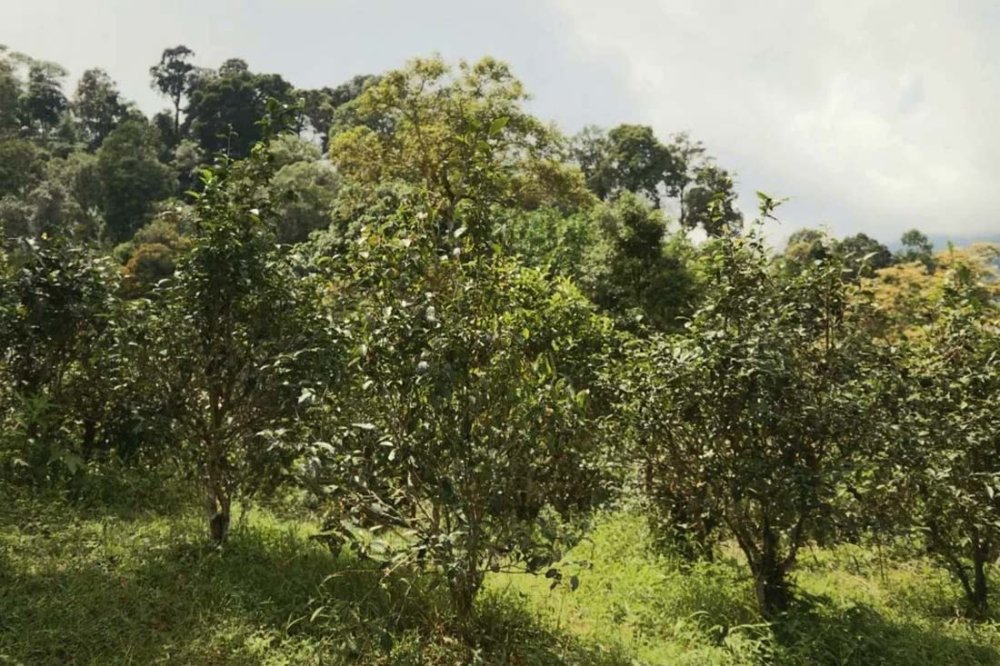
Zhanglang 章朗 – a Thousand-Year-Old Bulang Village
At an altitude of more than 1,600 metres above sea level lies the village of Zhanglang, the largest Bulang settlement in all of Xishuangbanna. Its mountain climate, frequent mists, abundant rainfall and fertile soils create ideal conditions for growing tea.
Zhanglang is remarkable not only for its tea. It is one of the oldest continuously inhabited villages of the Bulang people and, according to a stone stele preserved in the local Buddhist temple, has a history of more than 1,400 years. Traditional Bulang architecture, language, clothing and everyday customs have survived here to this day, making the village one of the most important cultural centres of this ethnic group.
Nearly one thousand mu of ancient tea gardens extend through the surrounding forests. Many of them, however, were left largely untended for decades. Today, the tea trees grow among tall grasses, shrubs and broadleaf trees. Unlike in some other famous regions, the trees here are not exceptionally massive – most trunks measure around 70–80 centimetres in diameter. They have, however, undergone very little pruning and often reach heights of five to six metres, making the harvesting of their leaves relatively demanding.
Manmai 曼迈 – Tea Gardens Among the Forests
About twenty kilometres from Zhanglang lies another important Bulang village, Manmai, at an altitude of approximately 1,560 metres. Tea gardens surround the village on all sides, although the largest concentrations are found on the forested slopes behind the settlement. The area is characterised by purplish-red, stony soils rich in minerals.
Local residents recall that as recently as forty years ago, more than a thousand mu of ancient tea gardens stretched around the village. Today, approximately half of them remain. Even so, Manmai is still one of the most valuable tea-growing areas of Bada Mountain.
The road connecting Manmai with the administrative centre of Xiding is known as the “tea scenic road”, as tea plantations extend along both sides of the route, including several production bases belonging to Menghai Tea Factory.
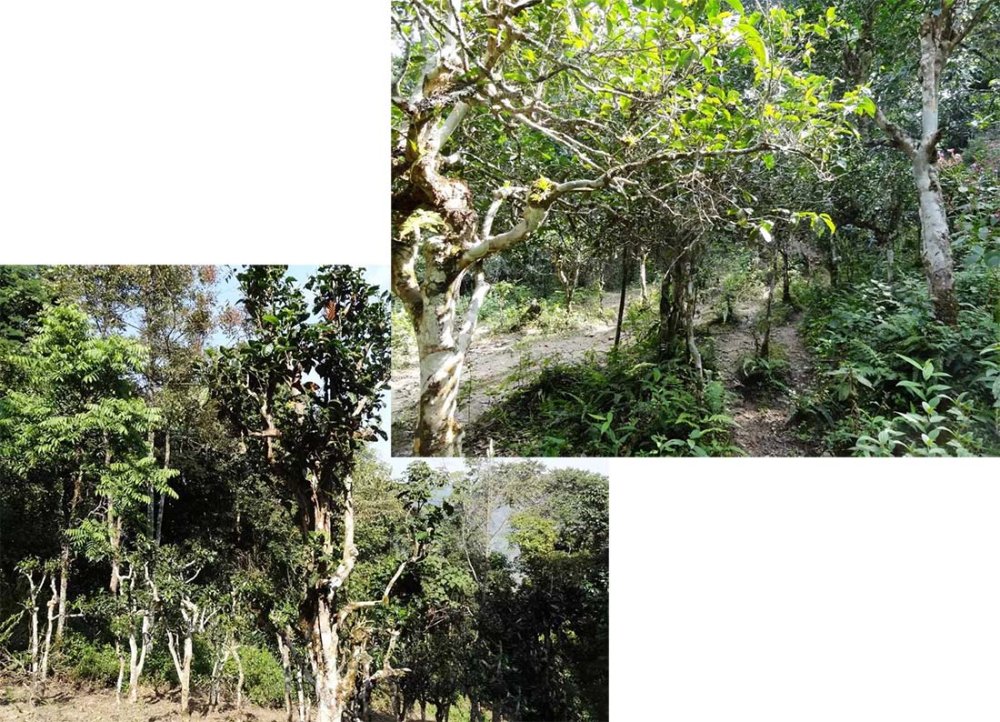
The ancient tea trees of Manmai grow predominantly within natural forest. The forest has been barely cleared of shrubs or companion trees, allowing the tea trees to grow in a genuinely natural environment. Most trees exceed two metres in height and have a tree-like growth habit. Large-leaf varieties (大叶种) predominate, while only a smaller proportion consists of tea trees with smaller leaves.
Character of Bada Mountain Teas
Pu'er teas from Bada have a distinctive mountain character. The dry leaves tend to be tightly twisted, dark and glossy. The infusion has a clear golden colour, while the aroma is pronounced, clean and persistent, often remaining noticeable even at the bottom of an empty cup.
The taste is characterised by fairly distinct bitterness and astringency, which quickly transform into a pleasant returning sweetness (回甘, huígān). The liquor is full-bodied and smooth, with a pronounced shan ye qi 山野气 – the characteristic “energy of the mountain wilderness” associated with high-quality ancient tea trees growing in an undisturbed forest environment. It is precisely this combination of strength, purity and rapidly returning sweetness that makes Bada Mountain teas a favourite among lovers of authentic pu'er from ancient trees.
Recommended products1


2018 Badashan Ripe Pu-erh Mini Cakes | Bada Shan Shu Cha
10,45 € excl. VAT