

Ancient Tea Trees and Legends of the Jinuo Mountains 基诺

The Jinuo Shan 基诺山 mountain range, formerly known as Youle Shan 攸乐山, is one of the most famous tea-growing regions of China's Yunnan Province and is traditionally regarded as the first of the Six Ancient Tea Mountains (六大茶山). Today, it is known above all for its extensive groves of ancient tea trees (gushu 古树), many of which are several hundred years old. For the local Jinuo people 基诺族, however, tea has never been merely an agricultural crop. It is part of their identity, history and spiritual world, something still reflected in the legends passed down from generation to generation.
The oldest of these legends tells of the creator of the world, Amo Yaobai 阿嫫尧白. After creating the world, she assigned each people their own land and means of livelihood, but the Jinuo are said to have failed to appear at the great gathering. The goddess feared that they would be unable to survive in the remote mountains, so she scattered a handful of tea seeds across the slopes of Jinuo Shan. Wherever they fell, mighty tea trees grew, and the people learned to live from tea. To this day, the Jinuo say that tea is a gift from the gods, one that enabled their people to survive.
Even better known is the legend connecting the local tea with the famous military strategist Zhuge Liang 诸葛亮, also known as Kongming 孔明. During his southern campaign in the Three Kingdoms period, part of his army is said to have remained behind in the mountains after exhausted soldiers overslept and missed the departure of the main force. The strict Zhuge Liang refused to take them back, but he did not want to leave them at the mercy of the wilderness. He gave them tea seeds and taught them how to cultivate tea. According to the legend, these soldiers became the ancestors of today's Jinuo people, and Zhuge Liang is still revered here as the Tea Ancestor (茶祖). Although historians cannot confirm the story, its significance was strong enough for it to find its way into the Puer Fu Zhi 普洱府志, a chronicle from the Qing dynasty. It even states that Zhuge Liang left a different object on each of the six tea mountains during his journey, and that an ancient tea tree on Mangzhi Mountain 莽枝 was believed to have grown from his seeds.
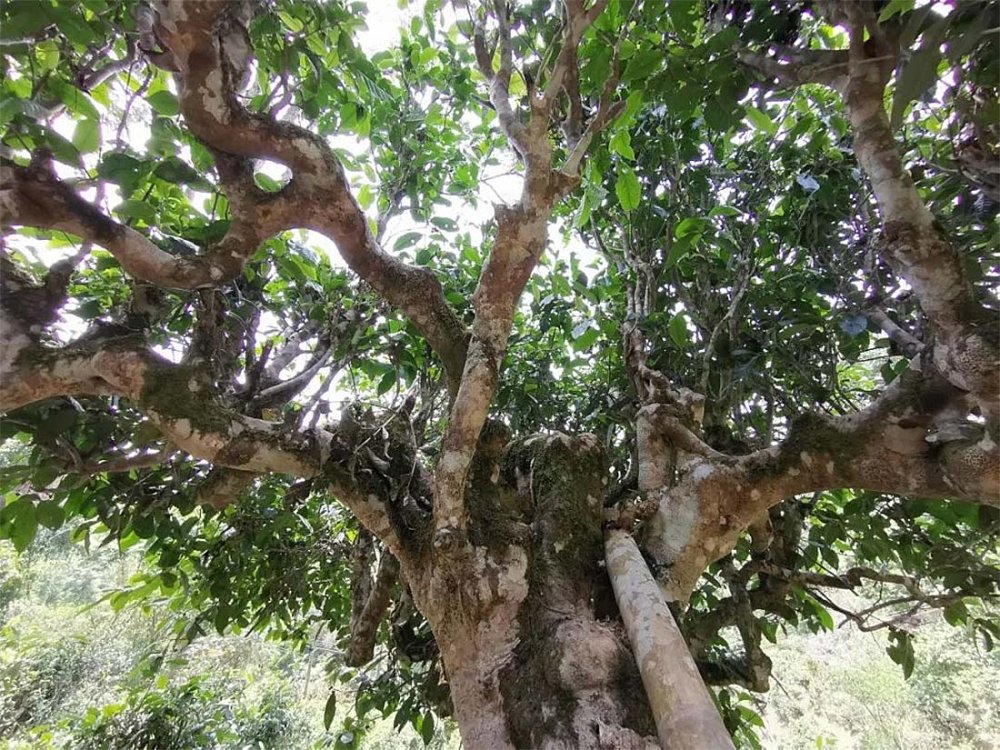
Although historical sources do not confirm these legends, they do show that tea has been cultivated in this region for a very long time. As early as the 9th century, the work Yunnan Zhi《云南志》 described tea growing in the mountains of the Yinsheng region, where local people prepared it together with ginger, pepper and cinnamon. Several centuries later, Jinuo Shan became one of the most important areas of pu'er production, and during the Qing dynasty an administrative centre was established here to oversee the tea trade. Caravans carried tea from these mountains throughout the empire, and the name Youle Shan became a symbol of exceptional quality.
Today, the ancient tea trees of Jinuo Shan are admired above all for their remarkable terroir and the unique character of the teas they produce. Yet the stories that have grown around them over the centuries are no less precious. Whether tea was brought to the mountain by the goddess Amo Yaobai or by the legendary Zhuge Liang, both stories express the same idea – that tea is not merely a plant, but part of the cultural memory of the people who have lived with it for generations. This is precisely why visiting the ancient tea gardens of Jinuo Shan feels so extraordinary. Among the mighty trunks, whose roots reach deep into the red mountain soil, it is easy to understand why history and legend remain almost inseparably intertwined here.